
After intensive field testing the Blue Diversion Toilet was transported back to Sanergy's premises where it was dismantled and prepared for shipment back to Switzerland.
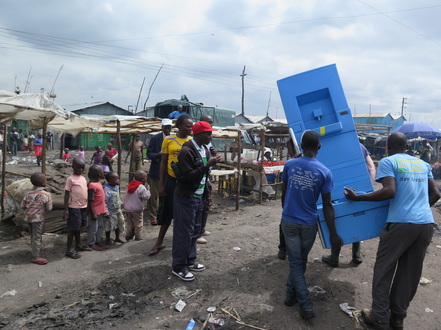
Challenging the reengineered toilet
We are satisfied with the results of the field test, although it was very challenging. The goal of the field test was to validate the totally reengineered working model under real conditions. Therefore, 10 people were asked to use the toilet over a period of one month and the public was invited to use it on public usage days and to provide their feedback as well.
The results of the previous field test in Kampala, Uganda, in 2013 led to a complete reengineering of the Blue Diversion Toilet. The reengineering focused on reducing the toilet size and simplifying the use of the toilet because both attributes were criticized by the users. The latter included replacing the foot pump by electrical pumps which led to a more sophisticated electronics set-up. We knew from the beginning that more electronics would pose a challenge, but we wanted to try it anyway, because electronics are comparatively cheap components for an envisaged large volume production. We were also aware that the toilet base (containers) had not yet reached prototype stage. However, early field testing proved to be very valuable and was a reason for conducting this field test with a toilet that was not yet a full prototype.
Let's have a closer look at the results. The field test in Nairobi was accompanied by a social science study funded by Eawag. Sixty interviews with regular users and 300 interviews with one time users were collected. The evaluation was largely positive and showed that people
- like the look of the toilet (100%)
- think it’s easy to use (95%) and
- would also recommend it to friends and family (94%).
Furthermore, a household survey with 1’400 people was conducted to gather information about the current sanitation situation in two informal settlements of Nairobi (Mukuru and Kibera).
Retrofitting possible in 50% of the toilets
The working model was successfully retrofitted in an existing Sanergy superstructure which was a major goal of the field test. However, moving different features for maintenance and servicing was challenging because of the extremely limited space within the latrine. Observations of 227 toilets during the household survey showed that retrofitting is possible in 50% of the toilets. For the field test the doorframe had to be removed temporary to install the toilet. This minor adaption is necessary for most of the superstructures as only 10% of the doors are large enough to fit the Blue Diversion toilet. Yet 72% of the eligible latrines are built with iron sheets and are therefore easier to adapt than other superstructures. Additionally the roof would also need to be raised in 30% of the toilets with a suitable surface area. These minor adjustments would allow avoiding the construction of an expensive new superstructure (~40% of on-site sanitation costs in East Africa).
We are satisfied with the results of the field test, although it was very challenging. The goal of the field test was to validate the totally reengineered working model under real conditions. Therefore, 10 people were asked to use the toilet over a period of one month and the public was invited to use it on public usage days and to provide their feedback as well.
The results of the previous field test in Kampala, Uganda, in 2013 led to a complete reengineering of the Blue Diversion Toilet. The reengineering focused on reducing the toilet size and simplifying the use of the toilet because both attributes were criticized by the users. The latter included replacing the foot pump by electrical pumps which led to a more sophisticated electronics set-up. We knew from the beginning that more electronics would pose a challenge, but we wanted to try it anyway, because electronics are comparatively cheap components for an envisaged large volume production. We were also aware that the toilet base (containers) had not yet reached prototype stage. However, early field testing proved to be very valuable and was a reason for conducting this field test with a toilet that was not yet a full prototype.
Let's have a closer look at the results. The field test in Nairobi was accompanied by a social science study funded by Eawag. Sixty interviews with regular users and 300 interviews with one time users were collected. The evaluation was largely positive and showed that people
- like the look of the toilet (100%)
- think it’s easy to use (95%) and
- would also recommend it to friends and family (94%).
Furthermore, a household survey with 1’400 people was conducted to gather information about the current sanitation situation in two informal settlements of Nairobi (Mukuru and Kibera).
Retrofitting possible in 50% of the toilets
The working model was successfully retrofitted in an existing Sanergy superstructure which was a major goal of the field test. However, moving different features for maintenance and servicing was challenging because of the extremely limited space within the latrine. Observations of 227 toilets during the household survey showed that retrofitting is possible in 50% of the toilets. For the field test the doorframe had to be removed temporary to install the toilet. This minor adaption is necessary for most of the superstructures as only 10% of the doors are large enough to fit the Blue Diversion toilet. Yet 72% of the eligible latrines are built with iron sheets and are therefore easier to adapt than other superstructures. Additionally the roof would also need to be raised in 30% of the toilets with a suitable surface area. These minor adjustments would allow avoiding the construction of an expensive new superstructure (~40% of on-site sanitation costs in East Africa).
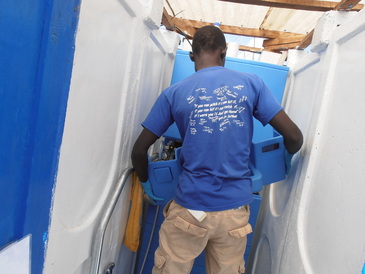
Retrofitting in existing structures does not leave much space for servicing
Hygienically safe water
The recycled water was hygienically safe during the entire field test period; meaning the water recovery worked well. The electrolysis cell was able to provide sufficient chlorine to prevent regrowth and proved effective in reducing the color of the water.
The new hydraulic system was leak-proof. Water for hand washing and the hand shower was available during the entire test period. The flush was programmed not to work when the water level in the clean water tank was too low which worked out well and was only the case for short periods with high usage, especially during the public user events.
The electronics posed the biggest challenge of the field test - as anticipated. There was a domino effect that occurred when the electronics and programming went wrong. For example: the level sensor in the treatment tank showed a constant volume above the actual limit of the tank volume. Therefore the water from hand shower and flush was automatically directed to the urine tank. As a result the recovery system constantly lost water to the urine tank. Thus the water recovery system had to be refilled more often and the urine tank had to be emptied more frequently because it filled up quicker.
The urine-water-separation mechanism was challenged by the large amount of thick mud due to the rainy season.
The recycled water was hygienically safe during the entire field test period; meaning the water recovery worked well. The electrolysis cell was able to provide sufficient chlorine to prevent regrowth and proved effective in reducing the color of the water.
The new hydraulic system was leak-proof. Water for hand washing and the hand shower was available during the entire test period. The flush was programmed not to work when the water level in the clean water tank was too low which worked out well and was only the case for short periods with high usage, especially during the public user events.
The electronics posed the biggest challenge of the field test - as anticipated. There was a domino effect that occurred when the electronics and programming went wrong. For example: the level sensor in the treatment tank showed a constant volume above the actual limit of the tank volume. Therefore the water from hand shower and flush was automatically directed to the urine tank. As a result the recovery system constantly lost water to the urine tank. Thus the water recovery system had to be refilled more often and the urine tank had to be emptied more frequently because it filled up quicker.
The urine-water-separation mechanism was challenged by the large amount of thick mud due to the rainy season.
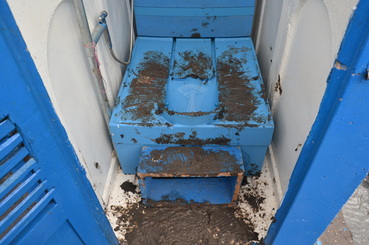 No, it's not feces :-)! The large amount of mud challenged the urine-water-separation mechanism |
Largely positive evaluations
We conclude that in general the field test was satisfying: The 60 interviews with regular users and 300 interviews with one time users provided largely positive evaluations of the Blue Diversion Toilet and we now have a clear picture about what needs to be improved:
by Rahel Künzle, Ulrike Messmer and Mark O'Keefe
We conclude that in general the field test was satisfying: The 60 interviews with regular users and 300 interviews with one time users provided largely positive evaluations of the Blue Diversion Toilet and we now have a clear picture about what needs to be improved:
- The hydraulic system needs further simplification and the number of components needs to be reduced
- Further development of the electronics and the software to make it more robust and less vulnerable to failures
- Further design work should focus on maintenance and servicing aspects. The collaboration with Sanergy gave important insights into the running of a reliable collection system and its challenges.
- Adapt the pan for muddy and water logged areas e.g. by expanding the product range with sitting module or an in-between sit-squat module to prevent mud from clogging the mechanism.
by Rahel Künzle, Ulrike Messmer and Mark O'Keefe
 RSS Feed

